Give Your Child the Gift of Bilingualism

Guest post by SANTIAGO MONTERO
Santiago Montero
Santiago is the founder and director of a language school in Washington DC. He has also worked tirelessly to integrate the fields of education and mass media in Europe and Latin America for the last fifteen years. You can read about Santiago, his methods and his school, at Spanish Tutor DC.

Not since some widely discredited studies in the nineteenth century have scientists had a bad word to say about bilingualism. On the contrary, mounting evidence suggests that bilingualism is good for us, and particularly good for our brains. From delaying the onset of Alzheimers to stimulating an increase in brain size, it seems to be now irrefutable that the acquisition of language has an extraordinary and unique role to play in shaping our body’s most enigmatic and complex organ. [Read more…]

The impact of late, non-balanced bilingualism on cognitive performance

Media reports on study by Bilingualism Matters researchers (January 2015)
Vega-Mendoza, M., West, H., Sorace, A., Bak, T.H. (2015). The impact of late, non-balanced bilingualism on cognitive performance. Cognition, 137, 40-46. doi:10.1016/j.cognition.2014.12.008

screencapture-www-scotsman-com-news-education-learning-a-second-language-can-boost-thinking-1-3663739

screencapture-www-heraldscotland-com-news-home-news-study-learning-second-language-boosts-thinking-skills-1421411942

screencapture-www-heraldscotland-com-news-education-learning-a-language-improves-mental-agility-116309404

screencapture-www-medicalpress-es-aprender-idiomas-mejora-la-agilidad-mental-a-cualquier-edad

Slovenian branch of Bilingualism Matters opens as part of AThEME project

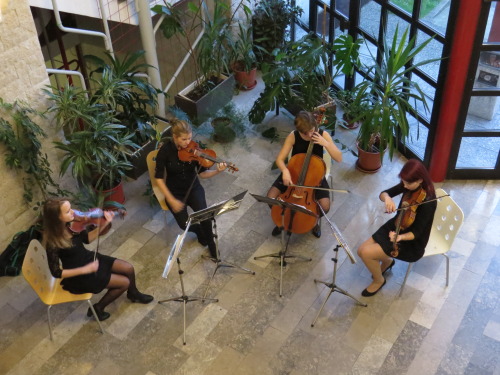
students peform music school of Nova Gorica perform at launch of Slovenian Bilingualism Matters

On 25th November 2014, the Slovenian branch of Bilingualism Matters (“Večjezičnost Velja”) was launched at the University of Nova Gorica as part of the AThEME project.

Welcoming addresses were given by Dr. Rok Žaucer, director of the Center for Cognitive Science of Language, prof. Dr. Mladen Franko, vice-rector of the University, Sandra Sodini, director of the European Grouping for Territorial Cooperation (EZTS) and by Dr. Sara Andreetta, director of the new branch. Professor Sorace from the Bilingualism Matters HQ in Edinburgh gave a talk on the major facts, challenges and benefits of bilingualism. The talks were followed by a musical performance from students of the Music school of Nova Gorica.

The following day Professor Sorace held a public lecture entitled “Bilingualism: an investment for families and society” in Gorizia, on the Italian side of the border between Italy and Slovenia.

Both events were attended by an audience very interested in the topic of bilingualism! Indeed, in many cases they were bilingual themselves in Slovenian and Italian languages, due to the particular condition of living in the border between the two countries.

Confessions of a late bilingual  

My name is Madeleine and I work for Bilingualism Matters. A large part of my job involves promoting the idea – to parents, teachers, public bodies – that early language learning (during pre-school and primary school years) is a Good Thing. Sadly, I have no personal experience on which to draw.

I grew up in an old salt mining town in north-west England, and it’s fair to say that it wasn’t exactly a hotbed of bilingualism. My first exposure to another language came at the local comprehensive: two hours a week learning the French present tense by rote while the boys (“Greeny”, “Hughsey”, “Clarkey”) drew on each other with chalk. At about the same time, I went to the local library and, for reasons I still can’t remember, requested a set of Teach Yourself Swedish cassettes that had to be ordered in specially from Manchester. I kept at it for months, acquired a Swedish penpal, all the while dreaming of the far off glamour of Nordic winters. Alas, most of the Swedish has long since deserted me, though I will always have a soft spot for Swedish athletes in the Olympics. And for Wallander, of course. [Read more…]

Does being bilingual make you smarter?

Research by Bilingualism Matters researcher Dr Thomas Bak featured in a discussion about bilingualism from Discovery Channel’s DNews.

Research article:
Bak, T. H., Nissan, J. J., Allerhand, M. M. and Deary, I. J. (2014), Does bilingualism influence cognitive aging?. Ann Neurol., 75: 959–963. doi: 10.1002/ana.24158

Bilingualism Matters: A Centre of Excellence

Professor Antonella Sorace and University Principal Professor Sir Timothy O'Shea cut the Bilingualism Matters cake at the launch of the new Centre

Bilingualism Matters has now officially launched as a Centre at the University of Edinburgh. Bilingualism Matters began as a public information service in 2008, in response to a lack of information about bilingualism in the community. Since its inception, the service has delivered hundreds of talks – to parents, educators, health professionals, business leaders, and policy makers – and responded to almost a thousand individual written requests for advice on raising bilingual children.

On Tuesday evening, teachers, speech-language therapists, language policy bodies, consulate staff and business leaders all gathered at the University of Edinburgh to mark a new chapter in the history of Bilingualism Matters.

University Principal Professor Sir Timothy O’Shea urged his audience to ensure that language learning remains a high priority for local and national government in Scotland. He also offered a challenge for those in the audience: “If you don’t have a second language, go and get one. If you have a second language; go and get a third”.

The Principal’s speech was followed by a personal account of bilingualism, as Edinburgh resident Joana Ferrão spoke about raising her young son with both English and Portuguese languages. Joana admitted that she sometimes meets resistance from well meaning parties who worry that her son will simply grow up confused; it is then, explained Joana, that it becomes really useful – and reassuring – to know about the research backing up her hopes. Interestingly, Joana stressed that for her, as for many bilingual parents, the possible cognitive advantages of bilingualism play only a small role in their motivation to raise a bilingual family. Far more important to Joana is her relationship with her child, her sense of passing on a cultural legacy, and valuing linguistic diversity in Scotland.

As Joana said during the launch: “Nothing can be more important than this feeling of love and acceptance in giving our children the best possible start in life”.

The creation of a dedicated new Centre will allow Bilingualism Matters to build on its existing work in our communities, and help make sure that all children grow up valuing their home language.

Antonella Sorace in het Parool Dutch newspaper

Dutch language interview and profile of Prof Antonella Sorace and Bilingualism Matters.

wetenschap-HetParool-25okt2014-3

Bilingualism Matters opens in the Netherlands

Dr Maaike Verrips opens the new branch of Bilingualism Matters in the Netherlands

The latest branch of Bilingualism Matters has opened in Amsterdam, as part of the major EU AThEME project.

The new branch of Bilingualism Matters is based in the Language Studio, who already host a successful language information website (Meertalig.nl). The branch launch was held to coincide with the Drongofestival , an annual festival celebrating the diverse languages and cultures in the Netherlands.

Valuing the home language

Dr Maaike Verrips, the force behind the Drongo festival and the new Director of Bilingualism Matters in the Netherlands, explained why such initiatives are needed.

“In the Netherlands, many ethnic minority parents attribute a low status to their home language. As a result, the families can end up communicating in a restricted mixture of limited home language, and limited Dutch. When parents and children don’t have a word in common, how can they communicate that concept between themselves? other parents, even the most well-educated, often worry (mistakenly) that speaking a second language will result in developmental delays in their child – completely the opposite of what research tells us. The Dutch branch of Bilingualism Matters can help make sure that when people make decisions about the language education of their children, they do so based on what we know from the scientific study of bilingualism.”

Professor Antonella Sorace travelled from Edinburgh to give a keynote address at the opening event, in which she also stressed that promoting bilingualism should not mean that we promote English above all other languages. The full video of her speech can be viewed on this youtube link , courtesy of the Drongo Festival team. An English transcript of the video is available as a pdf file: Bilingualism Matters in the Netherlands launch_Antonella Sorace

For more information about Meertalig and the Dutch branch of Bilingualism Matters, visit their website: Meertalig.nl
For more information on branches of Bilingualism Matters around Europe, visit our branches page: Bilingualism Matters branches

Explorathon 2014 is almost here

Lapin_Tania_book30

Bilingual puppet Lapin will be joining Bilingualism Matters at Explorathon 2014

Only one day to go until one of Europe’s largest public engagement events comes to Scotland, and Bilingualism Matters is thrilled to be taking part. Researchers will be putting on a range of events in Glasgow, Aberdeen, and Edinburgh, in order to bring their work to the public.

Bilingualism Matters will be available throughout the “Meet the Experts” session in the National Museum of Scotland (Edinburgh) from 13:00 – 16:30 on Friday afternoon. Come along to find out about our work in Edinburgh schools, the major new EU-funded AThEME project, or to chat to us about bilingualism or language learning. The team includes a mixture of researchers, teachers and parents of bilingual children, so now is your chance to ask us everything you ever wanted to know! About languages, that is. Particle physics is sadly not our department…

Some of you may know that tomorrow is also European Day of Languages (for those who did not know, you do now!). We are really thrilled that to help us celebrate, Le Petit Monde puppet theatre will be putting on two fantastic puppet shows alongside our stand, featuring their INCREDIBLY cute bilingual puppet Lapin. The shows are in French and English and are completely accessible to all children, whether they know any French or not.

Le Petit Monde puppet shows will take place at 14:00 and 15:00 in the Grand Gallery of the National Museum, next to the Bilingualism Matters stand. Duration 30 minutes; ages 3+.

For for information about le Petit Monde puppet theatre, visit www.lepetitmonde.co.uk

For the full Explorathon listings and to find an event near you, visit www.explorathon.co.uk

Spanish film festival in Edinburgh

tad the lost explorer spanish film

Roll up roll up and a very warm welcome to the 1st ever Edinburgh Spanish Film Festival!

Between 8th – 14th October, Edinburgh Filmhouse will be hosting a series of Spanish-language films to help ward off the autumnal chill.

With subtitles on all films, this festival is open to anyone with an interest in cinema or in Spanish/ Latin American culture (although, we also think it’s a great chance for the more rusty Spanish-speakers amongt us to sneak in a bit of practice).

The programme features films from up and coming directors such as Fernando Franco and Jonás Trueba, as well as more-established names like Icíar Bollaín, Cesc Gay and Gracia Querejeta. There really is something for everyone, from children and young people (have a look at family-friendly animation “Tad, the Lost Explorer”) to the most seasoned cinema buffs (sure-fire hits include the Oscar-nominated “15 Years and One Day”).

Find out more on the Edinburgh Spanish Film Festival’s website Edinburgh Spanish Film Festival 2014