Guest post by Tania Czajka (Le Petit Monde Puppet Theatre)
First of all, I want to say that since the day I have learned, I’ve always loved reading and writing. I remember very well the day when I could finally read a whole Oui-Oui book (Noddy in English). I was so excited!! I was going to learn lots of new things, enter worlds of stories I didn’t know! I also remember practising writing the letters of the alphabet in my special book. Fascinating it was!
With reading and mastering writing, came ideas which I put in short poems and I also illustrated them. By the age of 10, I had a wee collection of hand made books which I absolutely loved. This love for writing and reading has never left me. So when I moved to Scotland and – very gradually – improved my English, I naturally started writing children stories using both French and English. I had this strong desire to share my French language with young children but didn’t want to become a teacher.
So in 2008, I set up Le Petit Monde Puppet Theatre and decided my puppets would speak French. By then, I had a good understanding of both languages and could easily ‘jump’ from one to the other – like bilingual children do. So I wrote full bilingual scripts for my shows starring Lapin and his friends.
It has always been very important to me that the stories should be accessible to all very young non-French speakers. So:
- I carefully choose French key words – usually nouns – that are easy to guess or identify (e.g.. une carotte, une tomate).
- I then draft a story around these words and write a full script with the French words coming from the puppets.
- There is usually a period of playing with the script as I want it to flow naturally between the two languages, without translations.
- For very young children, I minimise the use of verbs and emphasise the noun key words.
I also believe the use of another language should be justified through the story, I have seen shows where suddenly, the audience is asked to count to 5 in French and nobody knows why. As a writer, I find this quite annoying, I must admit. In my case, I am French, I come from Paris and so do my puppet friends. So it is totally justified and naturally makes sense to use the French language.
I also carefully avoid mixing both languages in the same sentences. That’s why in my scripts, the puppets only speak French and I speak both. Lapin is the only character who does not understand English so I speak French to him, while I can speak English to the others. This, I believe, gives the right balance of both languages in order for the story to still be understood and enjoyed by audiences.
My love for bilingual writing is stronger than ever as I am getting ready for new challenges! The first one will see me going back to my childhood dream of writing books with a Lapin Picture Book. 🙂 Secondly, I want to create a new bilingual show based on one of the Fables written by Aesop and translated in the 17th century by the French poet la Fontaine… So… as we say in French “J’ai du pain sur la planche !’ (‘I have bread on the board’) meaning ‘I will have lots to do!’ Lots of words to play with!
The wonderful world of words…
A Bientôt
Tania
The Wonde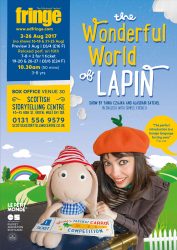 rful World of Lapin is showing at the Edinburgh Fringe 2017 (Aug 19-20, 26-27, 10.30am) at the Scottish Storytelling Centre.
‘The perfect introduction to a foreign language for tiny ones’ (The List)
‘Such a well-crafted, attractive and absorbing show which will always be well-received wherever it goes’ (Sylvia Troon, storyteller)
